The Cost of Waiting: Why Regulation and Reputation Decide the Fate of Water-Risked Plants
Ridhi Aggarwal & Monserrat Magaña Ocaña
2026-03-12 · 12 min read
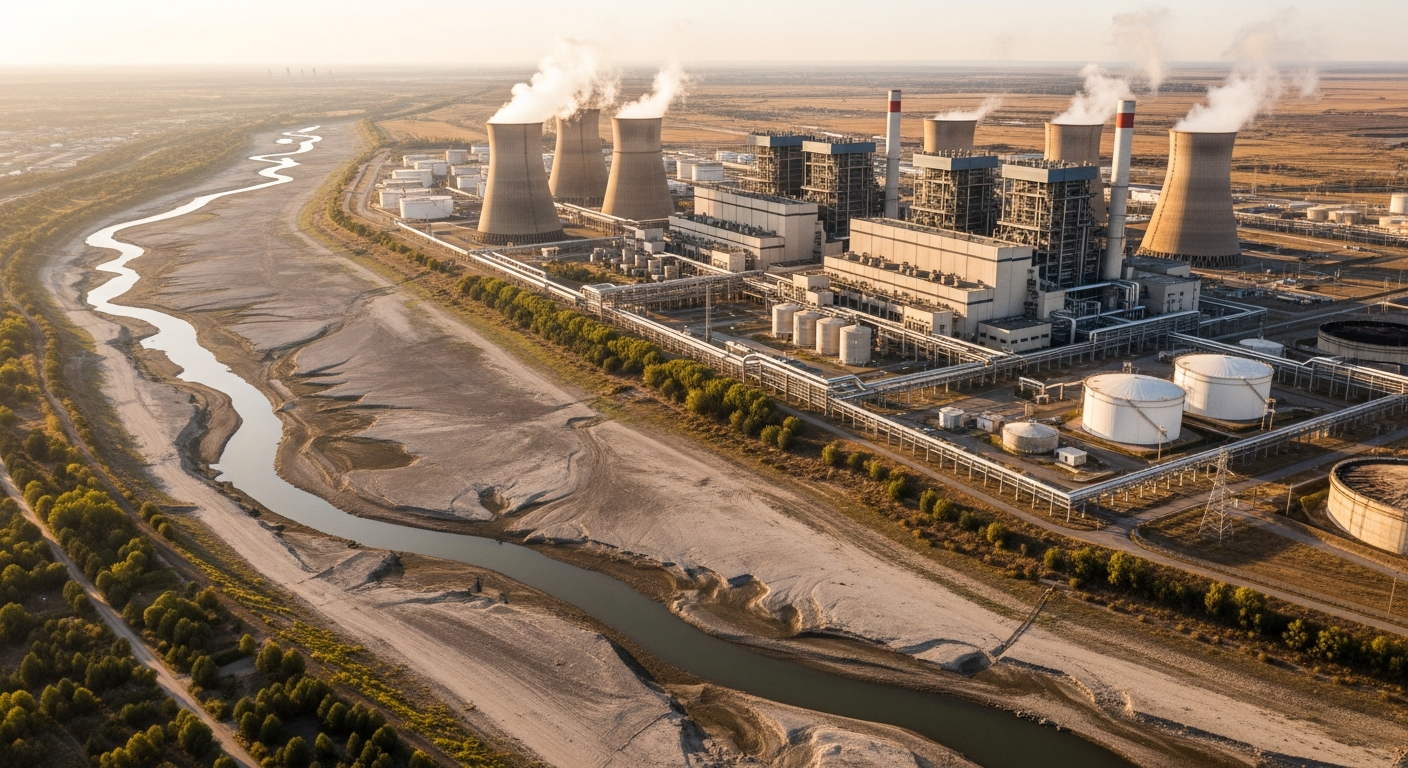
On a hot afternoon in southern France, the operators of the Golfech nuclear power station began watching the river more carefully than usual. The Garonne flowed quietly past fields and villages, but its temperature had begun creeping upward. Nuclear reactors depend on large volumes of water to dissipate heat, and environmental regulations in France impose strict limits on how warm discharged cooling water can be. When the river temperature approaches a legal threshold, 28 degrees Celsius, the plant must reduce output or shut down entirely to protect aquatic ecosystems.
The turbines were still capable of running. Fuel supplies were stable. Yet as the water warmed, the operators began cutting production. A gigawatt of power disappeared from the grid: not because of a mechanical failure, but because the river itself had become the binding constraint. Across Europe, similar episodes have repeated during heat waves and droughts, forcing utilities to curtail generation even when demand for electricity is soaring. What appears in financial reports as "temporary production curtailment" is, in fact, the direct consequence of water risk.
Events like this are becoming more common, yet corporate risk assessments often misunderstand how they occur. Water risk is frequently framed as a purely physical problem: how much water a facility needs, how much is available, and how infrastructure might buffer fluctuations in supply. That framing, however, misses the mechanism through which water scarcity becomes economically material. Industrial plants rarely shut down simply because a basin becomes drier.
More often, scarcity sets off a chain reaction involving regulatory enforcement and reputational escalation that ultimately forces the operational outcome.
The Two Pathways: Regulatory and Reputational
Understanding the difference matters for strategic planning and financial risk assessment. When water becomes scarce, two distinct but often overlapping pressures emerge. The first is regulatory: governments impose or enforce restrictions on water use, discharge, or extraction that directly constrain operations. The second is reputational: communities, media, or advocacy groups escalate public scrutiny of a company's water use, creating political pressure that can lead to indirect constraints such as permit revocations, mandatory impact assessments, or forced shutdowns.
Both pathways can lead to the same operational outcome — reduced production, temporary shutdowns, or even permanent facility closures — but they follow different timelines and respond to different interventions.
Regulatory Pressure: When the Law Becomes the Binding Constraint
Regulatory risk materializes when environmental agencies enforce water allocation limits, discharge temperature thresholds, or extraction permits. In well-regulated environments like the European Union, these constraints are codified and relatively predictable. Companies can model their exposure by analyzing historical enforcement patterns and projected climate scenarios.
The Golfech example illustrates this clearly. French environmental regulations set explicit temperature limits for discharged cooling water. When river temperatures rise, the plant must either reduce its thermal output or invest in alternative cooling infrastructure. The financial impact is quantifiable: lost generation revenue during peak demand periods, when electricity prices are highest.
Similar patterns emerge globally. Water extraction permits in drought-prone regions of Australia, South Africa, and parts of the United States have been curtailed during severe water stress events, forcing mines, farms, and industrial facilities to reduce output.
Reputational Pressure: When Communities Decide
Reputational pressure can be just as powerful. When water becomes scarce, industrial users inevitably become visible to surrounding communities. Questions arise about fairness: why should factories continue operating while households ration water? In regions where water supplies are shared between agriculture, cities, and industry, these tensions can escalate rapidly. Media coverage intensifies scrutiny, advocacy groups mobilize campaigns, and political leaders step in to address public concerns. The result is often a sudden tightening of regulatory oversight.
A striking example occurred in Peru in 2022, when a dispute between a mining company and nearby communities escalated into a blockade that cut off access to the reservoir supplying the mine. Rail lines were blocked, pipelines were closed, and operations were suspended. The conflict was not primarily about water availability in a physical sense — it was about perceived fairness, historical grievances, and political power. Once the reputational threshold was crossed, the operational consequences were severe and immediate.
This pattern appears across industries and continents. Mining operations in Peru have been halted when communities blocked access to reservoirs supplying industrial water. Semiconductor manufacturers in Taiwan have scrambled to truck water to fabrication plants during drought restrictions. Beverage companies operating in water-stressed regions have faced protests and legal challenges that ultimately forced facilities to close.
In each case, the operational outcome — shutdown, slowdown, or project cancellation — was triggered not by hydrology alone but by regulatory enforcement or reputational escalation. A very clear example was the shutdown of Constellation Brands' project in Mexico.
The Financial Stakes
Understanding this pathway is critical because the financial stakes are enormous. Corporate disclosures compiled through frameworks such as CDP indicate that potential financial impacts from water-related risks run into hundreds of billions of dollars globally. A significant share of that exposure is concentrated in assets that depend on water not only for production but also for regulatory compliance and community acceptance.
For companies operating water-intensive assets, the economic consequences of such conflicts can be severe. Short-term disruptions — such as emergency water procurement, regulatory fines, or temporary production cuts — may cost millions of dollars. More prolonged interruptions, including project delays or extended shutdowns, can escalate into tens or hundreds of millions. At the extreme end of the spectrum lie catastrophic events: environmental disasters, litigation, and permanent asset losses that can reach into the billions.
Beyond Engineering: The Strategic Response
This perspective also reframes the nature of water strategy. If water risk were purely a physical engineering problem, the solutions would focus on treatment technologies, storage capacity, or desalination infrastructure. While such investments are sometimes necessary, they are not always sufficient. Because regulatory and reputational dynamics often determine whether a plant continues operating, effective risk mitigation frequently involves broader interventions.
Companies increasingly invest in watershed restoration projects to stabilize basin hydrology, co-finance municipal water infrastructure, or implement community water access programs designed to reduce local tensions. These initiatives are sometimes described as sustainability programs, but their underlying function is economic.
By reducing the probability that water scarcity will escalate into regulatory enforcement or social conflict, they lower the expected cost of operational disruption.
Water risk is often described as the next frontier of climate-related financial risk. Yet the emerging evidence suggests something more complex. Scarcity alone rarely determines whether industrial operations continue or cease. The decisive factors are regulatory enforcement and reputational dynamics — forces that are shaped by politics, public perception, and institutional capacity as much as by hydrology.
For companies and investors seeking to understand and manage water risk, this distinction has profound implications. It suggests that effective water strategy must extend beyond engineering and supply management to encompass regulatory engagement, community relations, and institutional collaboration. The cost of inaction is not simply the cost of running out of water — it is the cost of waiting until regulation or reputation makes the decision for you.
Ready to quantify your water risk? Schedule a demo to see how Celeste turns water complexity into clear investment decisions.
Ridhi Aggarwal & Monserrat Magaña Ocaña
The Celeste team writes about water risk, climate finance, and enterprise resilience strategy. We help organizations make water a financial decision.